





Introduction
In global food manufacturing, skim milk powder (SMP) is often treated as a simple commodity ingredient. Buyers frequently compare suppliers based primarily on price per metric ton, assuming that all skim milk powders behave similarly in industrial formulations.
However, food technologists and formulation experts know that this assumption can lead to costly production challenges. Differences in heat classification, protein functionality, mineral balance, and microbiological quality can dramatically influence product performance in applications such as dairy beverages, bakery fillings, chocolate, and high‑protein foods.
As global dairy supply chains evolve in 2026, manufacturers importing skim milk powder must look beyond price and understand the hidden functional parameters that determine processing efficiency, product stability, and final texture.
Why Skim Milk Powder Is More Than a Commodity
Although SMP is produced through a standardized process—removing fat from milk and spray‑drying the remaining solids—small variations in processing conditions significantly affect functional performance.
For food manufacturers, this means that two SMP batches with identical protein and moisture specifications may behave completely differently during production.
Key functional characteristics include:
• Heat treatment classification
• Protein solubility and dispersibility
• Mineral balance
• Microbiological stability
• Rehydration behavior
Understanding these factors is critical when choosing bulk skim milk powder supplier for industrial applications.
Heat Classification: A Critical but Often Overlooked Parameter
One of the most important functional indicators in skim milk powder is its heat classification, typically categorized as:
• Low‑heat SMP
• Medium‑heat SMP
• High‑heat SMP
These categories reflect the level of heat applied during milk concentration and drying.
Low‑heat SMP generally retains higher whey protein functionality, making it suitable for applications requiring good solubility and emulsification, such as protein beverages or cheese production.
Medium‑heat SMP offers balanced functionality and is widely used in bakery and confectionery.
High‑heat SMP undergoes greater protein denaturation, which enhances water binding and viscosity, making it valuable in products such as yogurt, processed cheese, and ice cream.
For manufacturers importing skim milk powder, selecting the wrong heat class can lead to:
• poor solubility in beverages
• unstable emulsions
• inconsistent texture in dairy desserts
Read More: Differentiating Skim Milk Powder by Heat Treatment
Microbiological Quality and Spore Counts
Another factor often underestimated in procurement decisions is microbiological quality, particularly the level of heat‑resistant bacterial spores.
In high‑temperature processed foods such as UHT milk, evaporated milk, and dairy beverages, spores can survive processing and cause spoilage during shelf life.
Bulk skim milk powder suppliers with advanced filtration and hygienic processing systems are able to produce SMP with lower thermophilic spore counts, reducing risks in long shelf‑life products.
For manufacturers exporting finished products across international markets, this factor directly influences product stability and brand reputation.
Mineral Balance and Protein Stability
Skim milk powder naturally contains minerals such as calcium, phosphate, and magnesium, which interact with casein proteins.
The balance of these minerals can affect:
• protein aggregation during heating
• viscosity development
• stability in high‑protein formulations
In applications such as protein beverages, nutritional powders, and recombined dairy drinks, improper mineral balance may result in:
• sedimentation
• protein instability
• chalky mouthfeel
Advanced dairy processors carefully manage milk standardization and drying conditions to maintain consistent functional mineral profiles.
Rehydration and Solubility Performance
One of the most visible performance indicators of skim milk powder is rehydration behavior.
In industrial production environments where powders are dissolved in large mixing tanks, poor solubility can slow down processing and increase production costs.
High‑quality SMP should demonstrate:
• rapid wetting
• fast dispersion
• minimal lump formation
• high solubility index
Powders with optimized particle structure and agglomeration technology can significantly improve mixing efficiency in beverage, dairy, and bakery production lines.
The Growing Role of SMP in High‑Protein Foods
The global demand for high‑protein food products continues to expand rapidly across Asia, the Middle East, and Europe.
Skim milk powder plays an important role in these formulations because it provides:
• high‑quality dairy proteins
• natural milk flavor
• functional casein‑whey balance
• improved texture and body
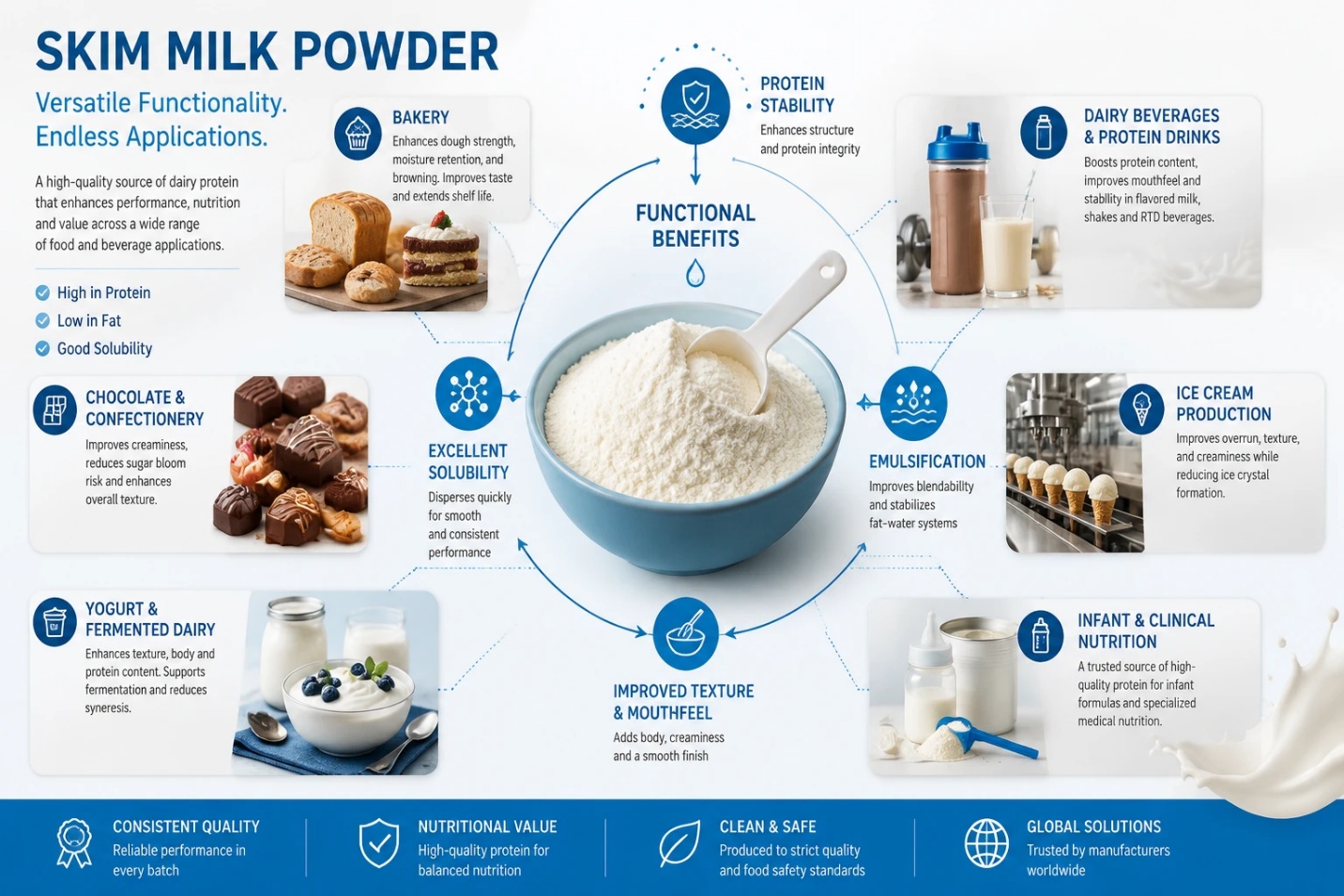
Applications include:
• protein beverages
• yogurt and dairy desserts
• bakery creams and fillings
• confectionery coatings
• ice cream and frozen desserts
In these products, the functional performance of SMP often determines texture stability, foaming properties, and overall sensory quality.
Global Supply Considerations for Importers
For manufacturers importing skim milk powder, choosing the right bulk skim milk powder supplier involves more than evaluating price and basic compositional specifications.
Reliable dairy ingredient suppliers should provide:
• consistent functional specifications
• traceable supply chains
• stable production capacity
• compliance with international quality standards
Global dairy markets have experienced increasing volatility due to climate conditions, feed costs, and regional milk production shifts. As a result, long‑term partnerships with dependable suppliers have become increasingly valuable for food manufacturers.
A strategic sourcing approach helps companies maintain consistent product quality while managing supply risks in international markets.
Why Technical Knowledge Matters in 2026
In an increasingly competitive food industry, manufacturers cannot afford to treat skim milk powder as a generic ingredient.
Understanding functional parameters such as heat classification, microbiological stability, mineral balance, and rehydration performance enables companies to:
• improve product quality
• optimize production efficiency
• reduce formulation failures
• maintain consistency across batches
For ingredient buyers and product developers alike, deeper knowledge of dairy powder functionality can transform SMP from a simple commodity into a strategic functional ingredient.

Conclusion
Skim milk powder remains one of the most widely traded dairy ingredients in global food manufacturing, yet many companies still evaluate it primarily based on price. In reality, the performance of SMP in industrial applications depends on a complex combination of processing conditions, functional properties, and microbiological quality.
Manufacturers that understand these hidden factors are better positioned to improve product stability, optimize formulations, and deliver consistent quality in increasingly competitive markets. This is where experienced ingredient suppliers play a crucial role.
Hiroland, as a bulk skim milk powder supplier, works closely with food manufacturers and B2B dairy ingredients buyers across global markets. By focusing on consistent quality, reliable supply chains, and functional performance, Hiroland supports a wide range of applications—from dairy beverages and bakery products to high‑protein formulations and frozen desserts.
In 2026 and beyond, the companies that succeed will be those that move beyond commodity thinking and recognize skim milk powder not just as a basic ingredient, but as a functional component with measurable technical value in modern food production.
Frequently Asked Questions
1. What is skim milk powder used for in food manufacturing?
Skim milk powder is widely used in dairy beverages, bakery products, confectionery, ice cream, yogurt, and high‑protein foods due to its protein content and functional properties.
2. What should manufacturers consider when importing skim milk powder?
Manufacturers should evaluate heat classification, microbiological quality, solubility, mineral balance, and supplier reliability in addition to price.
3. Why does heat classification matter in skim milk powder?
Heat treatment affects protein functionality, solubility, and water‑binding capacity, which directly influence product texture and processing performance.
4. How does skim milk powder affect texture in food products?
SMP proteins contribute to viscosity, emulsification, and water binding, helping stabilize textures in dairy desserts, bakery fillings, and beverages.
5. Is skim milk powder suitable for high‑protein formulations?
Yes. SMP provides high‑quality dairy proteins and functional casein structures that improve stability and mouthfeel in protein beverages and nutritional foods.
References
- FAO Dairy Market Review, 2024
- International Dairy Federation (IDF), Milk Powder Processing Guide, 2023
- OECD‑FAO Agricultural Outlook 2024–2033
- Walstra, Dairy Science and Technology (updated editions)
- European Dairy Association Market Reports, 2024
- Tetra Pak Dairy Processing Handbook
- Journal of Dairy Science – Milk Powder Functionality Studies, 2023–2024
- Global Dairy Trade Market Insights, 2024
- Dairy Foods Magazine – Global Dairy Ingredient Trends, 2025
- Food Ingredients First – Dairy Protein Market Analysis, 2024
Post a comment